
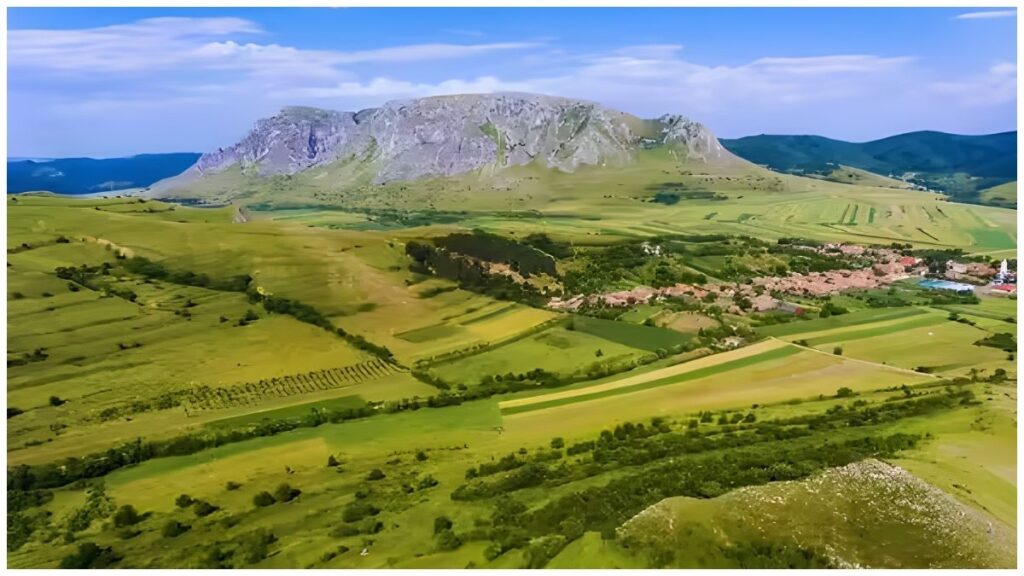
Rimetea is a small village in Alba County, Romania, located in the Transylvania region. Over the years, it has gained international attention for a rare natural phenomenon where the sun appears to rise twice in a single morning. This is not a myth or local legend but a clearly observable effect caused by the village’s unique geography.
The phenomenon has been documented by travellers, photographers, and researchers and is considered one of the clearest examples of a natural “double sunrise” created entirely by terrain.

Why Rimetea sees a double sunrise
Rimetea lies at the base of the Piatra Secuiului massif, a steep limestone mountain rising to over 1,100 metres. The village itself sits much lower, tucked into a narrow valley. This sharp difference in elevation plays a key role in the unusual sunrise.
The village is positioned almost directly west of Piatra Secuiului. As a result, the mountain briefly blocks sunlight during the early hours of the day.
On clear mornings, the sun first appears over the eastern horizon and becomes visible in the village, creating what looks like a normal sunrise. As the sun continues to rise, it moves behind the limestone cliff of Piatra Secuiului. For a few minutes, the mountain blocks the sunlight entirely, casting the village back into shadow. Shortly after, the sun climbs above the ridge and reappears, lighting up Rimetea once again. This sequence creates the illusion of the sun rising, setting, and rising again.
When the phenomenon is visible
The double sunrise is most noticeable during spring and autumn, when the sun’s angle aligns closely with the height and shape of the mountain. In summer, the sun rises earlier and at a steeper angle, which reduces the effect. In winter, the phenomenon can still occur, but fog, clouds, or poor visibility often make it harder to observe. Clear skies are essential.
The role of Piatra Secuiului
Piatra Secuiului is part of the Trascău Mountains, known for their abrupt limestone formations rather than gentle slopes. The mountain is also a popular hiking destination. From its summit, visitors can clearly see how the cliff interrupts sunlight reaching the village below, making the double sunrise easy to understand from above.
A village rich in culture and heritage
Beyond its geography, Rimetea is known for its well-preserved traditional architecture. Rows of whitewashed houses with green shutters reflect the area’s Szekely-Hungarian cultural roots. The village has maintained this architectural harmony over generations.
In recognition of its conservation efforts, Rimetea received the Europa Nostra Award in 1999, one of Europe’s most respected honours for cultural heritage preservation.
Life in Rimetea today
For local residents, the double sunrise is simply part of everyday life. There are no rituals or celebrations tied to it. Visitors, however, often arrive before dawn to witness the event, then spend the day hiking nearby trails or exploring the village on foot.
Rimetea’s reputation as the village where the sun rises twice is rooted firmly in science. Its dramatic limestone landscape and precise positioning combine to create a rare and striking natural spectacle that continues to draw visitors from around the world.